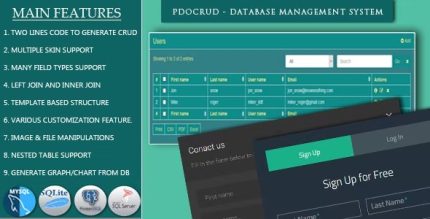
PDO Crud 7.2 – Advanced PHP CRUD application (Form Builder & Database Management)

PDO Crud for WordPress makes data management effortless by delivering fast, secure CRUD operations across MySQL, PostgreSQL, and SQLite. It simplifies app development, improving performance and scalability while offering seamless integration and beginner-friendly setup.
Description
PDO Crud is a PHP script set for WordPress that helps you perform reliable CRUD operations without adding complex database logic to your site. It uses PDO to manage Create, Read, Update, and Delete workflows efficiently across common database engines. By supporting MySQL, PostgreSQL, and SQLite, it fits a range of hosting environments and development setups. This makes it useful when you need to build or extend WordPress functionality that stores and retrieves structured data. The result is a cleaner approach to data management with better performance, easier scaling, and a beginner-friendly setup process.
Main Features
- PDO-based CRUD operations — Implements Create, Read, Update, and Delete patterns using PHP Data Objects.
- Multi-database support — Works with MySQL, PostgreSQL, and SQLite for flexible deployment.
- Secure database interaction — Uses PDO practices designed to help protect data handling during queries.
- Reusable PHP script structure — Organizes CRUD logic so you can adapt it for different WordPress data needs.
- Fast data retrieval — Streamlines read operations to keep interactions responsive.
- Update and delete workflows — Provides clear handling for modifying and removing stored records.
- WordPress-friendly integration — Designed to be used alongside WordPress development for database-backed features.
- Beginner-friendly setup — Helps you get CRUD functionality running with straightforward configuration.
Benefits
- Simpler development — Reduces the effort of writing database CRUD logic from scratch in WordPress projects.
- More consistent data handling — Keeps create, read, update, and delete processes aligned and easier to maintain.
- Better performance — Improves responsiveness by keeping CRUD operations streamlined.
- Scalability-ready approach — Supports growth by organizing database interactions in a reusable PHP pattern.
- Database flexibility — Lets you choose MySQL, PostgreSQL, or SQLite without changing your overall workflow.
Who is it suitable for?
- WordPress developers building database-backed features
- Small-to-medium business websites needing custom data management
- Blog and content sites with structured, admin-managed records
- Agencies creating WordPress solutions with reusable PHP components
- Teams working across different database environments (MySQL, PostgreSQL, SQLite)