
WooCommerce Lead Time 2.2.2 – by Barn2
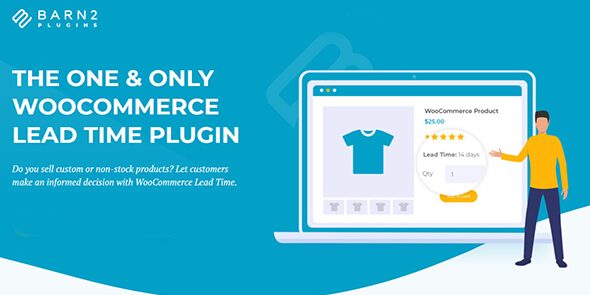
WooCommerce Lead Time shows individual and global lead times for products, displaying clear information to help customers decide whether to place an order. It boosts conversion by reducing uncertainty and cart abandonment, Type: Woocommerce, with easy integration and flexible display options. Explore this plugin and tailor lead times to your store for smarter purchases.
Description
WooCommerce Lead Time helps you set expectations for customers by showing how long it typically takes to prepare or deliver an item. Instead of leaving shoppers guessing, it provides individual lead times per product and a global lead time for your store. The result is clearer purchase decisions and fewer stalled checkouts caused by delivery uncertainty. Designed for WordPress and WooCommerce stores, the plugin integrates with your existing product setup and theme output. Use its flexible display options to tailor how lead time information appears to shoppers, helping you reduce cart abandonment while improving user confidence.
Main Features
- Individual lead time per product — Set a specific lead time for each WooCommerce product.
- Global lead time setting — Apply a default lead time across your catalog for consistent messaging.
- Clear frontend lead time display — Show lead time information so customers can evaluate timing before ordering.
- Flexible display options — Customize how lead time details are presented to shoppers to match your store style.
- WooCommerce-focused integration — Works with your WooCommerce product configuration without requiring a new workflow.
- Smarter decision support — Provide timing context at the point where customers decide whether to place an order.
- Theme-friendly output — Designed to fit into typical WordPress/WooCommerce layouts without forcing major changes.
Benefits
- Higher conversion confidence — Customers are more likely to buy when delivery readiness is clearly stated.
- Lower cart abandonment — Reduces drop-offs caused by uncertainty about lead times.
- Better UX clarity — Makes product timing expectations easy to understand during browsing.
- More accurate order planning — Aligns what customers expect with how long fulfillment typically takes.
- Consistent catalog messaging — Global defaults help maintain uniform communication across products.
Who is it suitable for?
- WooCommerce stores that sell made-to-order or pre-order products
- Catalogs with varying preparation times across different items
- Brands managing seasonal fulfillment or fluctuating lead times
- Agencies building WordPress sites for WooCommerce clients
- Online shops aiming to improve checkout completion rates
- Content-driven businesses that need clearer purchase intent signals